Ask a color consultant what season you are and you will hear one of four words: spring, summer, autumn, or winter. Ask again after a 16 season color analysis and the answer has two parts, deep summer instead of summer, soft autumn instead of autumn. Same skin, same features, but a name that actually points somewhere. The expanded system does not reject the classic four seasons; it refines them, and once you see what the extra word is doing, most wardrobe confusion starts to sort itself out.
Why 16 seasons instead of 4
The four classic seasons describe a temperament more than a recipe. Two winters can sit next to each other and look completely different: one with porcelain skin, jet-black hair, and icy eyes, the other with olive skin, dark brown hair, and hazel eyes. Both read cool. But their depth and contrast are worlds apart, so the same winter palette flatters one and flattens the other. I see this exact pair in consultations all the time.
How the 16 types split the four classic seasons
The 16-season system grew out of those gaps. When a client said they were a summer but kept fighting their summer colors, the missing information was usually one of two things: how light or deep the overall coloring is, and how muted or bright the chroma is. The expanded system adds those axes, so each classic season splits into more precise types.
Sixteen is not more correct than four, and I would not claim one system is objectively better. It is more precise, and precision matters at real decision points: choosing a lipstick, picking a neutral, explaining to a colorist what natural should mean. That is where the 12- and 16-season systems earn their keep.
Each school draws the map a little differently, which is the first honest caveat. In the most common versions, every classic season receives four slots: the home-base true type, a light or deep version, and a soft or bright version. Spring gives you light spring, true spring, bright spring, and warm spring; autumn gives you soft autumn, true autumn, deep autumn, and warm autumn. Summer and winter follow the same pattern, and some schools add an extra type where the old boundaries had a hole, which is how deep summer and soft winter entered the 16 color seasons count.
The point is the logic, not the exact roster. A season name tells you the family, warm or cool, and then one extra trait that dominates how that warmth or coolness should be applied. If you learn to read that second trait, the specific school matters less.
| System | What it separates | Where people fall through |
|---|---|---|
| 4 seasons | Warm versus cool, one type per family | Anyone cool but deep, muted but warm, light but bright |
| 12 seasons | Adds light, true, bright, soft, and deep types | Cool people darker than classic summer, warm people softer than classic autumn |
| 16 seasons | Adds in-between types like deep summer and soft winter | Far fewer; the remaining argument is usually naming, not a missing slot |
Reading the name of your season
The two-part name is a recipe, and the first word is the louder ingredient. In deep winter, depth governs everything; in bright spring, brightness does. When a palette feels almost right but never quite works, the secondary trait is usually the offender, and people blame the family instead.
One of my clients kept buying autumn browns because her eyes are warm brown. Her skin, though, is cool and muted, and the browns gave her that tired, sallow look she hated. Soft autumn fixed it: the softness first, the warmth second, colors a step greyer than true autumn. The name simply reordered her priorities.
Hair and eye color support the result; they do not decide it. Plenty of cool seasons have warm brown hair, and plenty of warm seasons have blue eyes. When a test result disagrees with your features, check the light you used before you check your eyes.
What a 16-season test actually checks
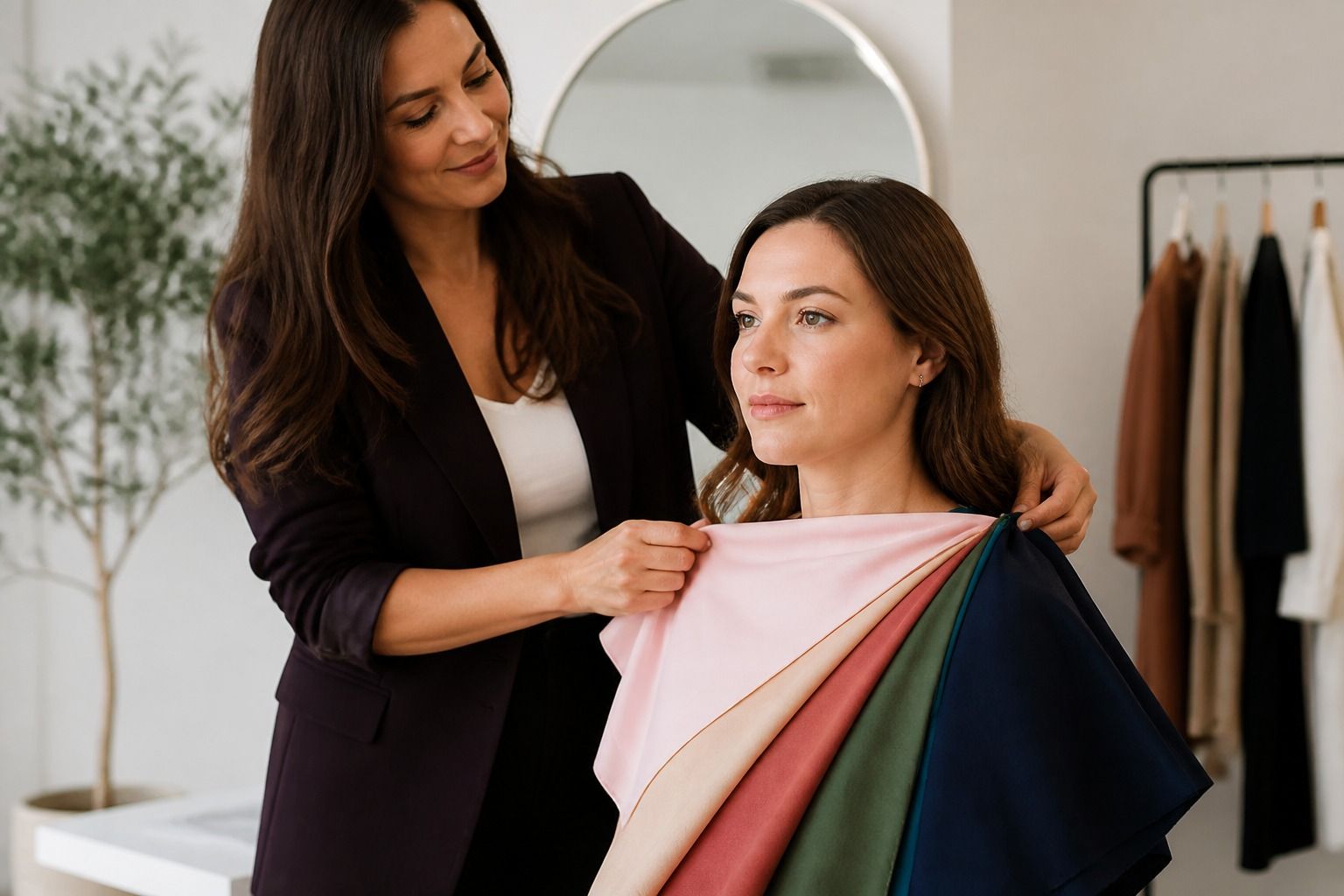
Draping in natural light is still the core of a serious 16 season color analysis. The analyst holds fabric swatches under your chin, one at a time, while you sit facing a window with no makeup and your hair pulled back. The interesting information is not which color you like; it is what happens to your skin. The right hue makes the area around the mouth look clear, while a wrong one drags shadows under the eyes or turns the skin sallow.
Beyond temperature, a good test checks depth and chroma separately. Charcoal versus mid grey versus light grey sorts your depth; a muted mauve versus a saturated berry sorts your chroma. Two people with identical undertones can land in different types because one can carry depth and the other cannot.
Keep expectations realistic. Results shift with the light, the set of drapes, and the analyst's school, and two good consultants may place the same person in adjacent types. An online 16 season color analysis test or quiz gives you a direction, not a diagnosis; treat the verdict as a hypothesis to confirm in daylight.
How to use the result in stores and salons
Walk into a store with the two-word name and you can skip half the rack instantly. Deep summer means heading to the cooler, deeper end of the summer section: skipping candy pastels, ignoring the neon table, and stopping at the plum, teal, and dusty blue rails. The name turns shopping from guessing into filtering.
Hold the garment under your chin and use three quick reads. If your skin turns grey, the shade is too muted or the undertone is off. If it turns yellow, the color is too warm. If it looks washed out, the color is too light. One of those three reactions appears within seconds; if none does, the color is doing its job.
In a salon, the season gives the colorist a target. Telling them you are a soft autumn sets a chroma goal rather than a hair-color debate; saying deep winter tells them to preserve depth and stay clear instead of warm. The result works best as shared vocabulary with the person holding the scissors.
The limits worth knowing before you commit
Seasonal color analysis is a framework, not a law, and a few things can shift the working palette. A tan deepens and warms skin temporarily, hair dye changes the contrast of your whole look, and age changes the texture and clarity of skin, which is why the same person may move one type over a decade.
Lighting also lies. Fluorescent fitting-room lights make cool skin look sallow and warm skin look orange; the draping that looked perfect by the window can look wrong at night. When in doubt, retest in daylight with bare skin.
The 16-season system is useful precisely because it gives a more specific direction than the four-season answer. It still leaves judgment to you: the mirror, the daylight, and the compliments you actually get. That is not a flaw in the system; it is the part of style that no map can automate.